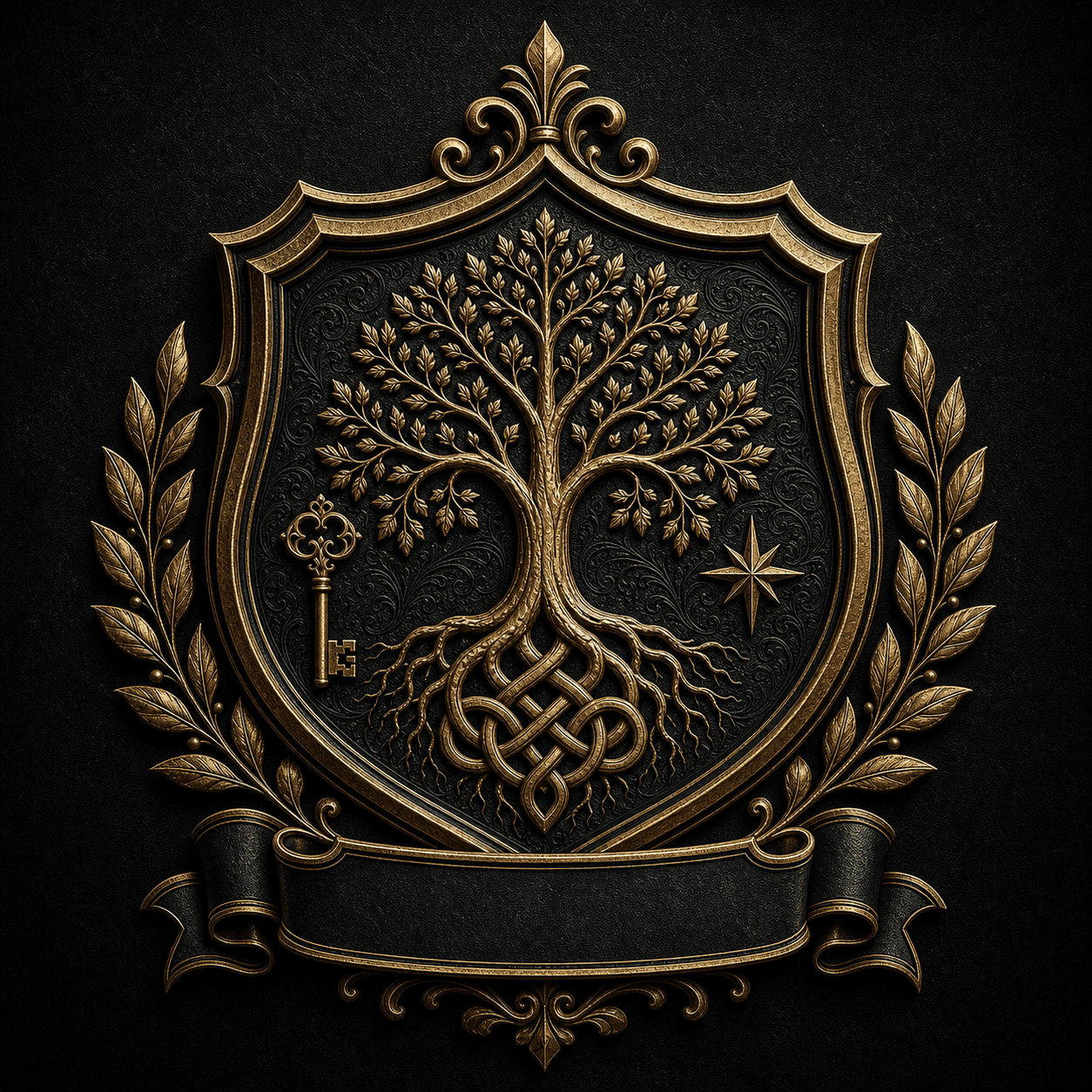
That boundary does not make the artwork less meaningful. It makes the process more honest. Instead of searching a surname database and accepting a shield that may have no documented relationship to your family, you can build a contemporary family emblem from people, places, memories, values, work, migration, traditions, and hopes your family actually recognizes.
The goal is not to imitate status. It is to make meaning visible.
This guide explains the difference between historical arms and modern symbolic family artwork, then provides a practical evidence-to-design process. You will learn how to choose one primary symbol, control supporting imagery, define composition and material, and write a Design Basis and Symbol Rationale that keep the final work accountable to the family story.
Modern symbolic art and historical arms are different things
In formal heraldry, coats of arms belong to particular people and lines of descent under the rules of the relevant heraldic tradition. The College of Arms states that there is no universal “coat of arms for a surname”; people with the same surname may have different rights—or no right—to particular arms.[1]
The word “crest” also has a narrower formal meaning than it has in everyday shopping language. In heraldry, the crest is a specific element placed above the helm, not the name for the whole design.[1]
A contemporary family crest for personal display operates in a different category. It may borrow visual structures associated with emblems—shields, medallions, branches, frames, ribbons, or symbolic animals—but it should not claim a historical grant, hereditary right, or genealogical conclusion.
Make this distinction explicit in the project description:
This is a contemporary symbolic family artwork based on information supplied by the family. It is not inherited arms, a grant of arms, genealogy, or proof of historical status.
If your actual goal is to establish entitlement to historical arms, consult records and the appropriate heraldic authority for the jurisdiction. A custom art service should not substitute decorative confidence for documentary evidence.
Begin with evidence, not a symbol catalog
The fastest way to create a generic design is to begin by choosing attractive symbols. Lions, crowns, eagles, swords, oak leaves, keys, stars, and shields can look impressive, but visual familiarity is not a reason to include them.
Begin with a short family evidence inventory instead.
People
Who is the artwork for? One parent, a couple, a grandparent, a whole family, or a new household? Confirm names, relationship language, pronouns, and whether one surname accurately represents everyone.
Places
Which places hold meaning? A neighborhood, workshop, coastline, mountain town, farm, school, country of migration, or home where relatives gathered can shape both symbols and background.
Contributions
What did the recipient or family actually do? Protection may appear as dependable care, resilience as rebuilding after hardship, wisdom as teaching, and craftsmanship as work made by hand.
Memories
Specific memories keep the design human. A lantern in a grandparent’s window is stronger evidence than “we like lanterns.” A key carried from an old home has more design value than choosing a key because it looks mysterious.
Values
Choose values the family can support with examples. Integrity becomes meaningful when tied to keeping promises. Hospitality becomes visible through an open table. Courage becomes credible when linked to a real choice or season.
Traditions and future hopes
Record what the family repeats and what it wants to continue. Avoid writing future success as a fact. Hope can guide a symbol without predicting anyone’s life.
Convert evidence into dominant meaning
Evidence is not yet art direction. The next step is to identify the meaning that best explains the material.
Use this sequence:
Evidence → meaning → emotional tone → symbol candidates
For example:
- Evidence: a father worked steadily for 35 years and protected family time.
- Meaning: protection through quiet responsibility.
- Emotional tone: dignity, gratitude, steadiness.
- Symbol candidates: shield, rooted tree, restrained laurel.
Or:
- Evidence: grandparents moved across countries and built a welcoming home.
- Meaning: journey becoming belonging.
- Emotional tone: courage, warmth, hope.
- Symbol candidates: compass, path, doorway, star.
Do not average every meaning into one crowded design. Rank them. A visual piece needs one dominant idea, a small number of supporting ideas, and clear exclusions.
Choose one primary symbol
The primary symbol should answer: “What is this design mainly about?” It receives the largest scale, strongest contrast, and clearest placement.
Useful primary choices include:
- Tree: continuity, growth, family connection, or generations—when those themes dominate.
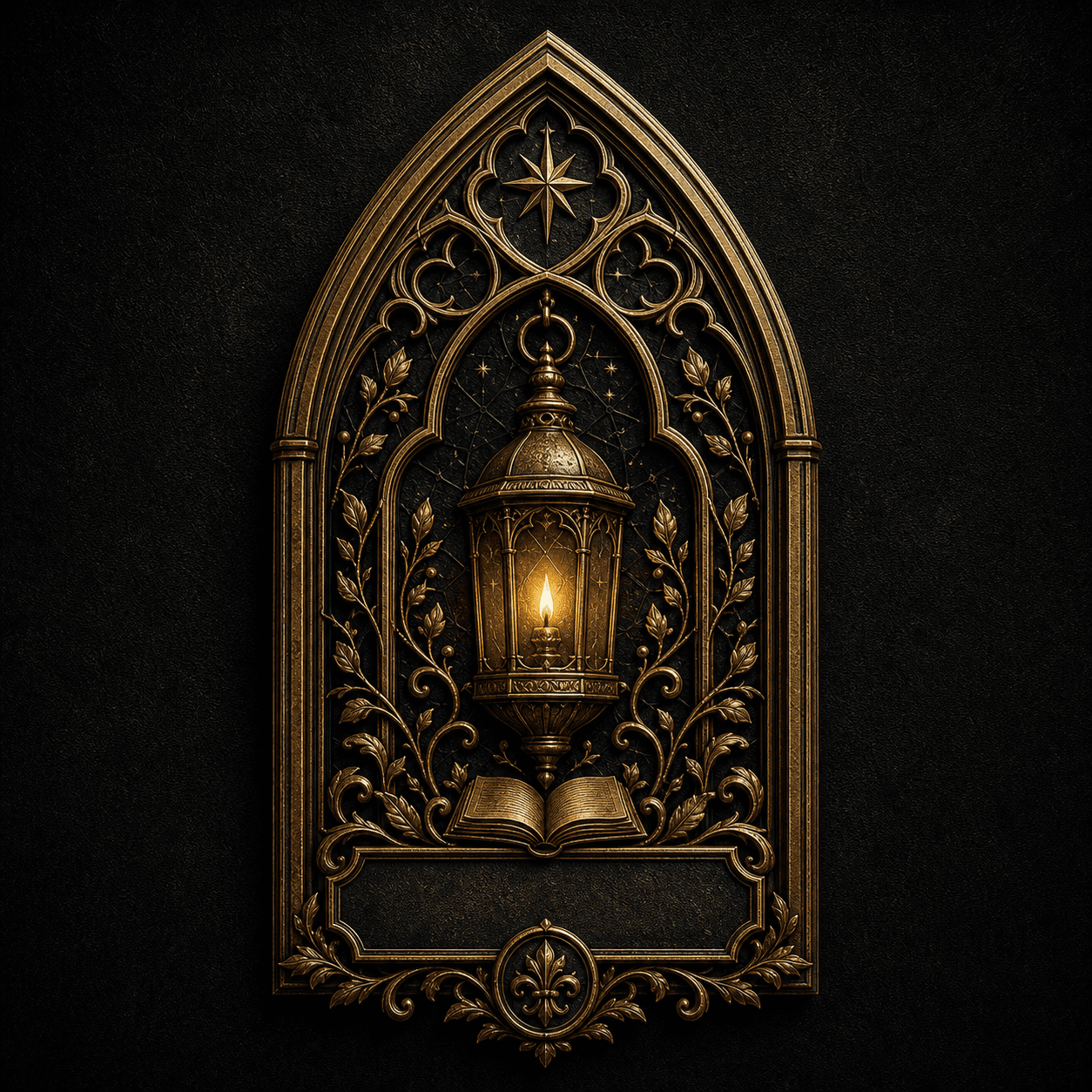
- Lantern: guidance, memory, or a person whose influence remains present.
- Compass: journey, migration, shared direction, or a new beginning.
- Mountain: endurance, resilience, a difficult path, or a meaningful landscape.
- Shield: protection, guardianship, steadiness, or a family role centered on keeping others safe.
- Book: teaching, knowledge, study, or family stories deliberately preserved.
No symbol has one universal meaning. A tree can suggest life, home, continuity, ecology, or faith depending on context. Cultural and religious interpretations vary. The design explanation should state the meaning assigned in this family’s project rather than presenting a private interpretation as universal fact.
The primary symbol should also fit the emotional tone. An aggressive shield with weapons would contradict a warm story about everyday care. A soft lantern may be too quiet for a story centered on bold exploration unless the evidence also supports guidance or remembrance.
Add secondary and structural symbols carefully
Secondary symbols clarify the primary idea; they should not compete with it. Limit the design to one or two.
A compass-led migration design might use a path as secondary and a star as an accent. A shield-led protection design might use a tree to connect protection with continuity. A lantern-led remembrance design might use an archive frame or book to support memory preservation.
Structural elements organize the artwork:
- a shield can act as a frame without being the primary meaning;
- laurel or branches can balance the sides;
- a plaque can create a stable base;
- an archive frame can create intimacy or ceremony;
- a ribbon can hold a short supplied motto, but should not invent one.
Structure is not automatically evidence. If a shield is included only to hold the composition, the Symbol Rationale should not suddenly claim that the family is defined by protection.
Create an exclusion list as seriously as a symbol list. Exclude:
- crowns and status ornaments when no relevant, appropriate evidence exists;
- religious imagery unless the family explicitly identifies faith as meaningful;
- aggressive weapons for stories centered on warmth, teaching, care, or remembrance;
- journey symbols when the story is mainly about home and stability;
- grief imagery for a celebratory occasion unless remembrance is genuinely part of the supplied evidence;
- decorative animals chosen only for appearance.
Define Symbol DNA instead of choosing generic icons
“Use a tree” is not enough direction. Symbol DNA describes how that tree should look and why.
For a family continuity story, the tree DNA might specify:
- broad, readable canopy rather than a narrow ornamental sapling;
- visible roots connected to the trunk;
- mature structure rather than dramatic wind damage;
- balanced branching to suggest shared growth;
- restrained detail so the image remains printable.
For a resilience story, mountain DNA might specify:
- one dominant peak rather than a decorative range;
- a visible upward path;
- strong base mass;
- controlled asymmetry suggesting movement;
- dawn light only if hope or new beginning is supported.
For a remembrance story, lantern DNA might specify:
- a contained warm light;
- stable vertical frame;
- archive-like detailing;
- no cemetery imagery unless the context requires it;
- surrounding darkness that supports dignity rather than fear.
DNA turns the family meaning into visual constraints. It also makes designs more distinguishable than changing a seed or swapping random icons in the same template.
Use composition, material, and light to serve meaning
Composition decides how the symbols relate.
Hierarchy
The primary symbol should be recognizable first. Secondary symbols should be readable next. Ornament should reward closer viewing without stealing attention.
Balance
Symmetry can suggest ceremony, stability, or continuity. Controlled asymmetry can suggest journey, change, or growth. Neither is inherently better.
Negative space
Empty space protects readability. A premium result does not need every surface filled with knots, flourishes, stars, and leaves.
Material
Antique gold can suggest a kept object, but it should not imply age or provenance the artwork does not possess. Dark engraved metal can communicate dignity. Ivory paper can support a certificate. Material is atmosphere, not historical evidence.
Lighting
Warm internal light supports lantern themes. Directional edge light can reveal engraved depth. Dawn light can support hope or beginning when earned. Dramatic theatrical beams may overpower quiet family stories.
Color
Color should support emotional tone and print use. Use a restrained palette unless the family provides a strong color connection. Do not assign a universal moral meaning to a color without qualification.
Write the Design Basis and Symbol Rationale
A modern family symbol becomes trustworthy when the reasoning can be inspected.
The Design Basis is a short paragraph connecting the supplied evidence to the overall visual decision. It should identify the recipient, occasion, dominant meaning, primary symbol, emotional tone, and composition direction.
Example:
This design centers on the family’s account of Elena as the person who kept a welcoming home through repeated moves. A compass leads because movement and shared direction are the strongest evidence. An open path supports the journey, while a restrained doorway marks the home those journeys created. Warm gold and balanced framing keep the tone hopeful and intimate.
The Symbol Rationale explains individual elements without turning them into dictionary definitions.
Example:
The compass represents the choices Elena and her family made together, not a claim about ancestry. The path reflects the moves named in the family’s story. The doorway refers to the home relatives described as consistently open to them.
These explanations also reveal errors. If the designer cannot connect a large symbol to supplied evidence in one clear sentence, the symbol probably does not belong.
In a complete keepsake, the Final Crest should remain the visual conclusion of that reasoning. One Heritage Certificate marks the occasion, one Family Story preserves the human evidence, and one Meaning Behind Your Crest guide explains the Design Basis and Symbol Rationale. The collection is delivered digitally with one Complete Collection archive. Those elements should support preservation and private sharing without repeating one another or turning symbolic interpretation into historical fact.
Compare three evidence-to-design examples
Retirement: quiet protection
Evidence includes decades of steady work, practical sacrifice, and integrity taught through example. The shield leads. A rooted tree supports family continuity. Laurel remains restrained because gratitude, not triumph, is the intended tone.
Wedding: shared direction
Evidence includes two equal recipients, different hometowns, a shared commitment to faith, and hopes for a welcoming home. A compass leads. Two paths may converge without implying one person is absorbed into the other. Faith symbolism appears only because it was explicitly supplied. The design avoids assuming a shared surname.
Grandparent remembrance: guidance carried forward
Evidence includes bedtime stories, a favorite reading chair, and the phrase a grandparent used when offering advice. A lantern leads because remembered guidance is central. A book supports the supplied reading memory. The closing visual tone moves toward hope rather than remaining in grief.
The same visual template would fail these three stories. Their primary symbols, hierarchy, DNA, composition, and emotional tone should be visibly different.
Commissioning checklist
Before approving a custom family emblem, ask:
- What real family evidence does the designer request?
- Is one primary symbol clearly identified?
- Can every major element be explained?
- Are unsupported symbols excluded?
- Does the service clearly distinguish symbolic art from historical arms?
- Is a Design Basis or equivalent explanation included?
- Does the final artwork fit print and digital display?
- Are names, pronouns, occasion, and supplied details checked?
- Will the files include clear usage and preservation guidance?
- Does the result look specific to this family rather than a surname template?
Be cautious when a service claims to identify a design for anyone sharing a surname. The College of Arms explicitly rejects the idea that arms universally belong to a surname.[1]
Build from what your family can recognize
A modern family crest does not need an invented past. It needs an honest present: real people, remembered places, demonstrated values, and a visual system disciplined enough to leave unsupported symbols out.
You can create a modern family symbol grounded in your own people, places, values, and memories, review the symbolic family crest approach, read what a family crest means in historical and modern contexts, or compare real example collections.
Buyer questions
Frequently asked questions
Can I create a modern family crest for my own family?
You can commission or create contemporary symbolic artwork for personal use. Describe it honestly and avoid presenting it as inherited, granted, registered, or historically verified arms.
Is a modern family crest the same as a coat of arms?
No. A personal symbolic design is not automatically a coat of arms. Formal heraldry has specific terminology, traditions, and jurisdiction-dependent rules. In formal usage, a crest is only one component of an achievement of arms.[1]
Can a surname tell me which coat of arms belongs to my family?
Not by itself. The College of Arms states that arms do not belong to everyone sharing a surname. Establishing a historical right requires appropriate genealogical and heraldic evidence.[1]
How many symbols should a modern family emblem include?
Use one primary symbol, up to two secondary symbols, and only enough structural or accent detail to support the idea. More symbols do not create more meaning.
How should I choose a primary symbol?
Choose the symbol that best represents the strongest supplied evidence and dominant meaning. Test it against emotional tone, visual clarity, and the ability to explain it in one sentence.
Can I use a shield in contemporary symbolic artwork?
Yes, as a personal visual structure or a symbol of protection, provided the project does not misrepresent it as historical entitlement. State whether the shield is meaningful or simply structural.
Should a family motto appear on a ribbon?
Only if the family supplies and approves the words. Do not invent Latin, authority language, or a slogan that makes the artwork sound historically established.
What makes one modern family crest different from another?
Different evidence should change the primary symbol, supporting symbols, Symbol DNA, hierarchy, composition, material, lighting, and written rationale. Swapping names inside the same template is not deep personalization.
Sources
References used for factual guidance
- FAQs: heraldry — College of Arms